Why your boiler is leaking water in South Carolina

After this form, you can stop searching for a boiler pro.

Let a pro reach out

Why is my boiler leaking water?

A puddle under the boiler or water dripping from a pipe fitting gets your attention fast, especially with a system you count on to keep the house warm when it's cold outside. Most homes in South Carolina run on electric heat, so a water boiler here is usually doing something specific, like heating the house through a radiator or baseboard loop. A leak means a part has failed or pressure in the system is off, and it needs a look before it gets worse.

A failed seal, a cracked fitting, or pressure that's too high

Water usually escapes from a boiler at one of a few spots: the pressure relief valve, a pipe fitting, or the pump seal. The relief valve lets water out on purpose when pressure inside the system climbs too high, which points to a problem with the expansion tank or the pressure regulator. A fitting or seal that's failed just wears out over time and lets water seep through even at normal pressure. Either way, the leak itself is a symptom, not the whole problem, and it won't stop until whatever is causing it gets fixed. Left alone, it can lead to rust inside the boiler, damage to the floor or area around it, and a system that loses pressure faster than it should, which affects how well it heats your home.

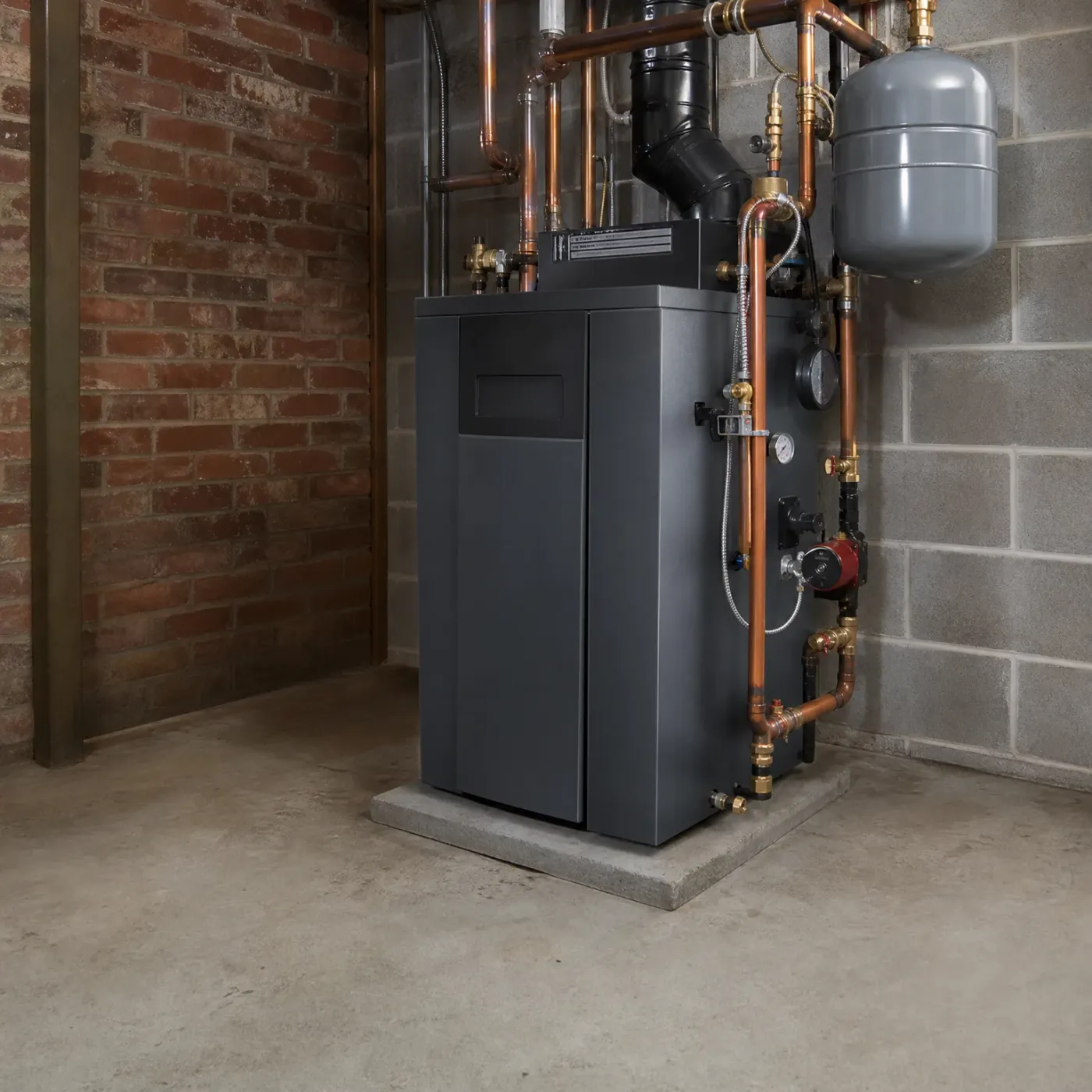
A dark gray floor-standing boiler on a concrete pad in a basement, connected to copper piping, valves, a circulator pump, a gauge, a black flue pipe, and a gray expansion tank, with a brick wall on the left and concrete block wall behind.

No leak, normal pressure

A boiler running right stays dry. The pressure gauge holds steady, the fittings stay tight, and the expansion tank does its job absorbing the pressure changes as water heats and cools. No drips, no rust forming on the floor underneath.

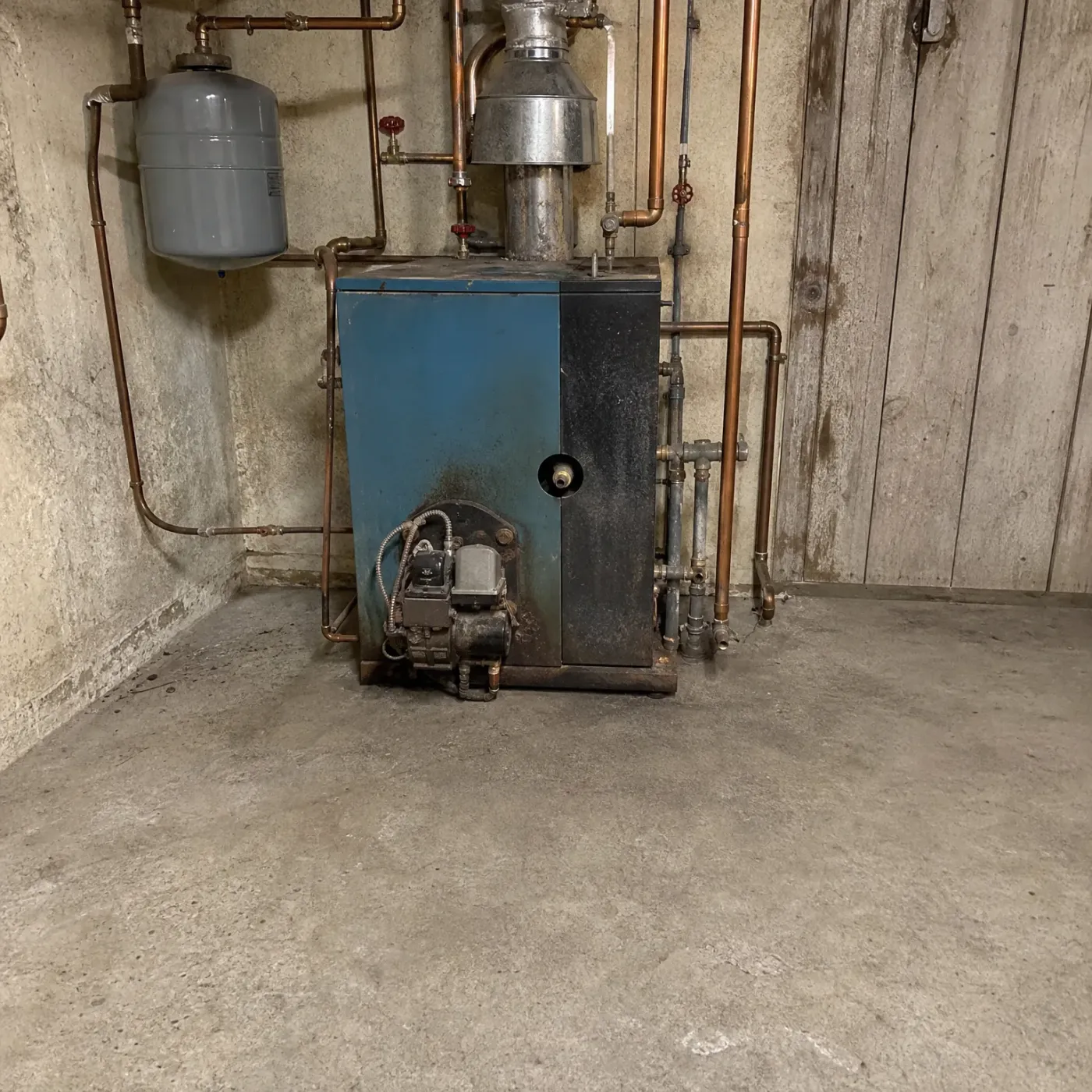
A blue and black boiler with a burner unit, flue, expansion tank and copper and steel piping stands on a concrete basement floor against a concrete wall and wooden plank partition.

Leaking at a fitting or valve

Water finds a path out through a loose fitting, a worn valve, or a cracked spot near the expansion tank. Left alone, it keeps dripping and the pressure in the system drops. A licensed contractor can trace it to the actual source instead of just guessing.

What's that puddle near your boiler telling you

You'll probably notice it before you understand it. Water pooled near the base of the boiler, a damp patch spreading across the floor, or a steady drip you can hear from another room. Sometimes it's a rusty ring on the concrete where water has dried and left minerals behind. The pressure gauge might be creeping up or down instead of holding steady. If the boiler sits near drywall or wood framing, water left to sit will soften the material around it over time, and a damp boiler room tends to smell musty before anyone sees the actual leak. None of that fixes itself, and a boiler that keeps losing water will eventually trip on low pressure and leave the house without heat.

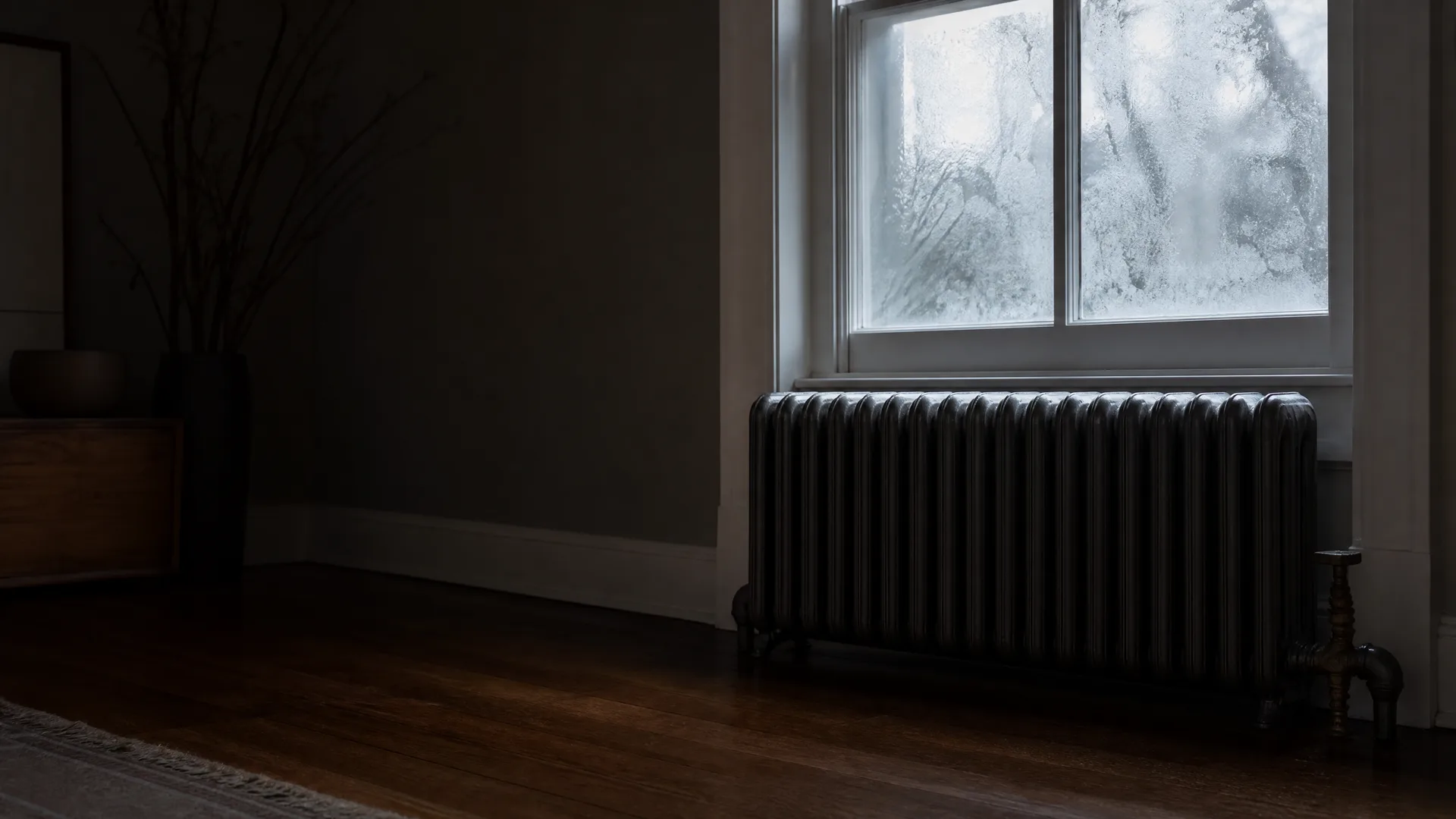
A cast-iron column radiator stands beneath a frosted window in a dim room with dark walls, a wood floor, and a vase of bare branches on a low cabinet at left.

You're up early, before the rest of the house. January, and the cold snapped hard overnight, enough that ice formed on the inside of the window glass above the radiator. The cast iron under the sill is cold to the touch where it should be warm. You crouch down and see it, water pooled on the floor beneath the boiler, a thin trail running toward the register vent. You press a towel against it and it's soaked through in a minute. The house still has that early morning quiet. You stand there a second, listening to the pipes, trying to figure out if it's gotten worse since last night or if you just never noticed it before now.


Hand off the boiler problem

A boiler is rare in South Carolina. Most houses here heat with electricity, so yours is already an exception, and that means it needs someone who still works on this equipment regularly, not a crew that sees one twice a year. A leak doesn't wait for a convenient week. Left alone, it drops the pressure, air gets into the system, and the boiler can shut itself down or start short cycling right when you need the heat most. Sending the request means a licensed contractor local to South Carolina gets it, one who deals with boilers often enough to know which fitting or valve tends to go first on systems like yours. Only that one contractor sees your request. You're not fielding calls from five companies trying to win the job, just waiting on the one who already knows what to look for.

A boiler holds water under pressure, usually somewhere between 12 and 15 psi when the system is cold. That pressure is what keeps the water moving through the pipes and radiators without turning to steam before it should.

Once a seal, valve, or fitting gives out, that same pressure is what pushes the water out through the weak point. The higher the pressure, the faster a small leak turns into a puddle you can't ignore.

A gray residential boiler with a metal flue pipe stands in a concrete-block basement corner, surrounded by copper piping, valves and a gray expansion tank.
Before you get your boiler repair
A dark gray floor-standing boiler in a concrete-walled basement, connected to copper piping, circulator pumps, a gray expansion tank, and a cream-colored storage tank to the left.
After you get your boiler repair

Every leak traces back to one part doing exactly what it was built to do, or failing at it. The relief valve is supposed to open once pressure gets too high, so a drip there at normal pressure means grit or a worn seal is keeping it from closing all the way again. Minerals in the water don't cause a leak on their own, but they build up as sludge each time the system gets refilled, and that buildup wears at seals and seats over time. The expansion tank is part of the same picture. It holds a cushion of air so the water has somewhere to go as it heats, and once that air charge is gone, the relief valve ends up doing the tank's job. Circulator pumps wear from the inside, at the shaft seal, so water shows up at the housing long before the pump itself quits. Cast iron sections crack along the stress points from years of heating and cooling, and a hairline crack there often only shows itself once the boiler's running hot.

Where the water actually comes from

  • Boiler water carries dissolved minerals, and every time a system gets refilled after a leak, it adds fresh minerals that settle out as sludge or scale.
  • The pressure relief valve is built to open and release water once pressure climbs past its rated limit, usually around 30 psi, to protect the boiler from damage.
  • A relief valve that drips with the system at normal pressure has usually got grit caught in the seat or a worn seal that won't reseat fully.
  • Circulator pumps have a shaft seal that wears over years of operation, and once it fails, water seeps out where the pump housing meets the motor.
  • Cast iron sections expand and contract with every heat cycle, and a hairline crack there will often only weep water once the boiler is running hot.
  • Expansion tanks hold a cushion of air that absorbs pressure as water heats, and a tank that's lost that air charge forces the relief valve to open instead.
A gray boiler with a metal flue pipe stands in a basement against concrete and concrete-block walls, connected to copper piping, a circulator pump, and two gray expansion tanks.
Copper lines run tight to every fitting, the expansion tanks hold steady, and the floor underneath stays dry.
A gray boiler on a concrete pad in a basement with painted concrete block walls, copper piping, a metal flue, and electrical control boxes.
A raised pad and an older setup like this often means more joints and more years for a seal to give out.
  1. Water heats and expands, pushing pressure up inside the boiler

  2. A worn seal, valve, or joint gives way under that pressure

  3. Water escapes at the weak point and finds the nearest gap

  4. It drips down the boiler's body or along a pipe

A woman with shoulder-length brown hair wearing a beige knit cardigan sits in a gray upholstered armchair near a window, looking off to the side with a slight smile, with bookshelves blurred in the background.
A woman with her hair in a bun holds a sleeping young child against her chest, both wrapped in a textured beige knit blanket on a sofa in a dimly lit room with a lamp, framed picture, and bookshelf behind them.

Winter nights average 36°F statewide

A 36°F night here isn't the kind of cold that stresses a furnace, but it's enough to keep your boiler cycling steadily most nights from December through February. That steady cycling is what pushes pressure through every seal and fitting, and it's usually where a slow leak starts.

NOAA nClimDiv 1991-2020 county normals weighted by homes

A boiler leaks because something under pressure gave out: a seal, a valve, a fitting, a joint that finally let go after enough cycles of heating and cooling. That's the whole answer. Where it's leaking tells you roughly what failed, but only someone who opens the system up can say for sure and fix it so it stays fixed. With a boiler this rare in South Carolina, that someone needs to be a contractor who still works on this equipment regularly, not one who sees a boiler twice a year and guesses. Send the request and the search for that contractor stops being your problem. You get matched with one licensed, local contractor who knows this equipment, not a handful of companies competing for your callback. The puddle doesn't get smaller on its own, and the longer it sits, the more it tells you the leak isn't slowing down. Get it looked at, get it sealed, and get your heat back to running the way it did before any of this started.

A man with grey hair and stubble in a dark sweater sits on a grey sofa indoors, looking off to the side, with a potted plant and a sunlit window behind him.
A man with gray hair, a beard and glasses, wearing a dark green sweater, sits on a gray sofa in a sunlit living room with a potted plant, table lamp and wooden sideboard behind him.
A middle-aged man with graying hair and a short beard sits on a blue sofa in a living room, looking toward a window, with a bookshelf, lamp and framed picture in the background.
A man with graying curly hair and a dark green sweater sits on a gray sofa in a sunlit living room, looking off to the side, with a framed picture, shelving, an armchair and a window with sheer curtains behind him.

Boiler Repair

Let someone else find the pro

The pro who reaches out is licensed in South Carolina.

A black-framed smartphone standing upright against a plain white background, its screen filled with solid green.
Step 1 of 3: Equipment