Tell us about the job
Takes about a minute. No obligation.
A boiler repair in Greenville County starts with the parts that cycle hardest. Homes in Greenville County, SC run heat about seven months a year, from October through April. That kind of runtime accumulates in the ignition system, the heat exchanger, and the burner assembly: the components that fire and reset every time the thermostat calls for heat. A contractor diagnosing a failed boiler here checks those first, because they absorb the load of a full heating season rather than the standby components that sit largely untouched. Corrosion at the heat exchanger and igniter wear tend to show up together on older units.
Boilers in housing this old have had a long time to accumulate the specific failures that make repair unpredictable: heat exchangers that have cycled through more seasons than most components are built to handle, and controls whose original wiring shows its age once a technician gets inside. Half the homes in Greenville County, South Carolina were built in 1992 or earlier (2020-2024 ACS 5-year). That span between when these houses were built and what runs in them now is where the repair scope actually gets set, and a contractor working on a boiler here expects to make decisions based on what the opened unit contains, not on what the exterior suggests.
The Parts of a Boiler a Contractor Checks First
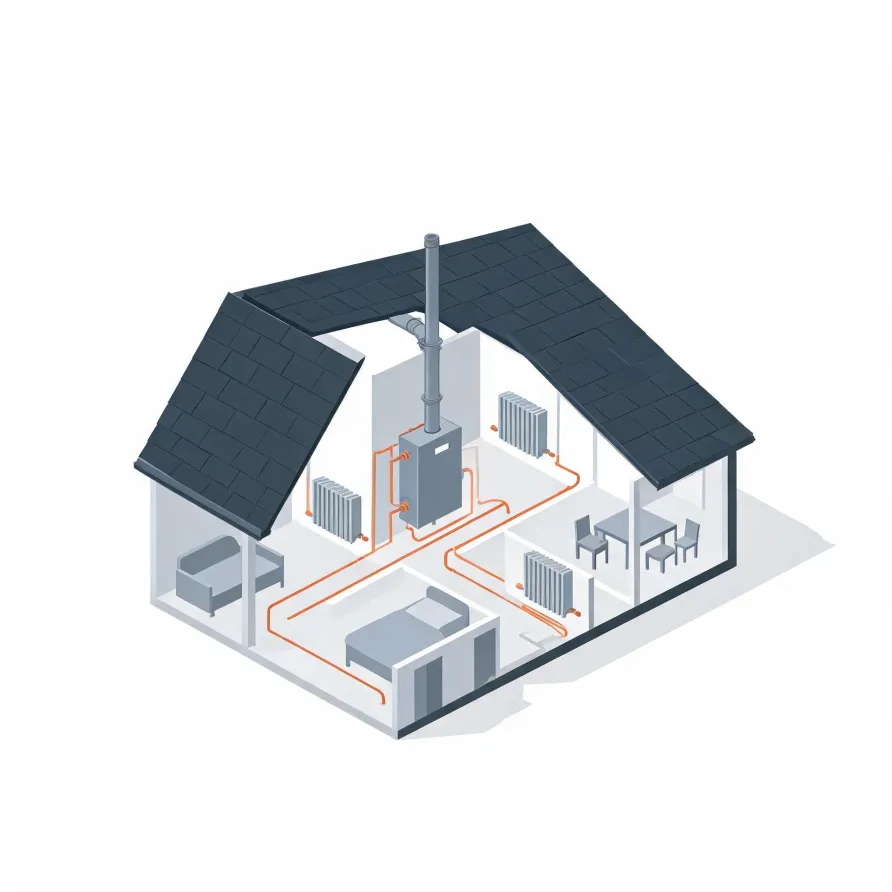
The boiler itself sits in a mechanical room, basement, or utility closet and is the unit that heats water and circulates it through the system. When something goes wrong with heat output or pressure, the contractor starts here, checking the heat exchanger, burner, and pressure relief valve for signs of wear, corrosion, or failure.
Radiators or baseboard units sit in the living spaces and are where a fault shows up as uneven heat or cold spots. The circulator pump, expansion tank, and shutoff valves connect everything and are the pieces a contractor traces when the boiler fires but the heat does not reach the room.
The drawing shows a typical boiler layout, and a licensed contractor determines which components apply to your specific system.
Get matched in Greenville CountyGreenville County, by the numbers
215 severe weather events were recorded in Greenville County, South Carolina between 2015 and 2024.
NOAA National Centers for Environmental Information, Storm Events Database, bulk CSV export, events 2015-01-01 through 2024-12-31.Half the homes in Greenville County, South Carolina were built in 1992 or earlier (2020-2024 ACS 5-year).
U.S. Census Bureau, 2020-2024 American Community Survey 5-Year EstimatesGreenville County, South Carolina holds 238,260 housing units (2020-2024 ACS 5-year).
U.S. Census Bureau, 2020-2024 American Community Survey 5-Year EstimatesOwners occupy 68.9% of the occupied homes in Greenville County, South Carolina (2020-2024 ACS 5-year).
U.S. Census Bureau, 2020-2024 American Community Survey 5-Year EstimatesBoiler Repair Rules on the Books for Greenville County, South Carolina1 codes, standards & statutes
Licensing Rules for HVAC Repair in Greenville County, South Carolina
South Carolina requires a mechanical contractor license for contracting work whose total cost of construction is greater than ten thousand dollars.
Severe Weather Events in Greenville County
Boilers work hardest when outside conditions swing hard, and Greenville County's weather puts real cumulative stress on heating systems over time. That stress shows up as wear, and wear shows up as repair calls.
215 severe weather events, 2015–2024. Source: NOAA National Centers for Environmental Information, Storm Events Database.